
The evidence courts expect and why it must be preserved from day one
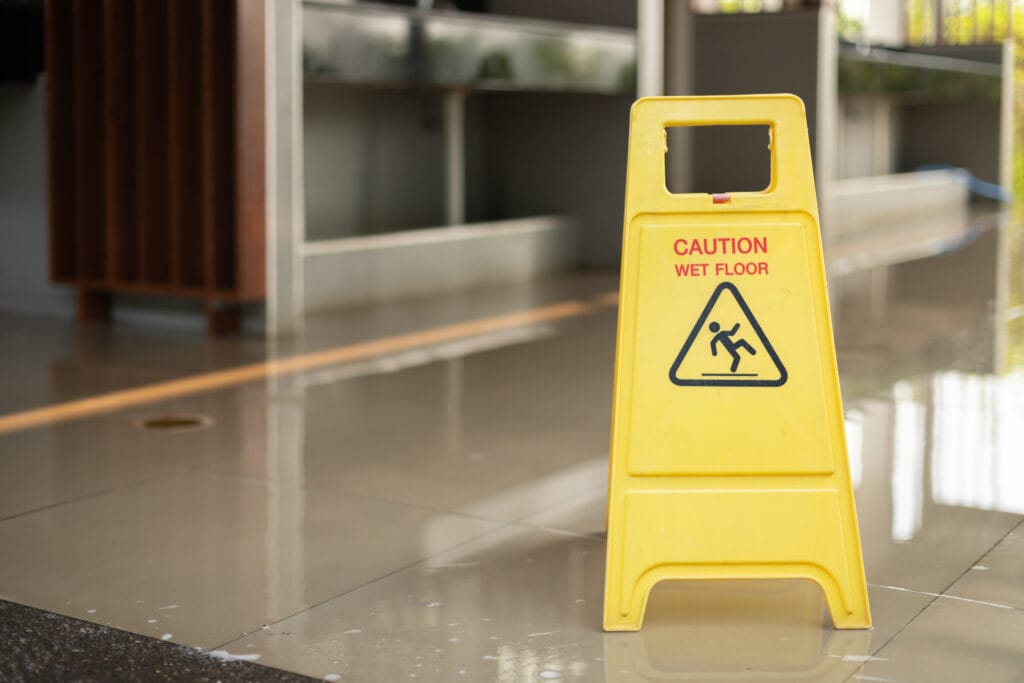
Appellate case law in Georgia supports that slip‑and‑fall claims are not to be decided by the seriousness of the injury or the mere fact that a fall occurred. They rise or fall on evidence. To obtain summary judgment, a premises owner must be able to show, through admissible proof, that it lacked superior knowledge of the hazard or that the plaintiff had equal or greater knowledge and failed to exercise ordinary care.
For insurers and retail insureds, defensibility is often determined in the hours immediately following an incident. When critical evidence is preserved early, claims may be resolved efficiently or dismissed outright. When it is not, even defensible claims can become difficult to resolve.
1. Surveillance Footage
Surveillance footage is often the most persuasive evidence in a Georgia slip‑and‑fall case because it may provide the only objective proof of whether a hazard existed, how long it was present, whether employees inspected the area, and how the claimant behaved before and after the alleged fall.
When footage exists, it often resolves notice and causation issues in a manner that supports early dismissal or summary judgment.
Timing is the greatest roadblock. Many systems overwrite footage within days, and once video is lost, it cannot be recreated. Georgia courts routinely recognize that the absence of objective evidence can leave material factual disputes, even where the defense otherwise appears strong.
Carrier Guidance – What to Tell Insureds
- Preserve footage from all cameras covering the incident area
- Retain footage from before, during, and after the incident
- Treat footage as relevant unless defense counsel advises otherwise
2. Incident Reports and Witness / Employee Information
Incident reports are often completed immediately after an alleged fall, before a claimant has had time to reflect on the event or shape a litigation narrative. As a result, they frequently capture the most contemporaneous description of what the claimant reported occurred.
When surveillance footage is unavailable or unclear, incident reports may be a viable source for understanding what the claimant initially identified as the cause of the fall, where it occurred, and whether an alleged hazard was even identified. They are also often the only reliable record of who was present and who observed the incident.
Collecting complete personal contact information – full names, personal phone numbers, and personal email addresses – for the claimant and all employee witnesses is critical, including the employee who completed the report. Slip‑and‑fall claims often do not reach defense counsel until years later, and employee turnover in retail environments is common. By that point, store emails or internal contact information are frequently no longer valid.
Without personal contact information, key witnesses may be unreachable, preventing the defense from obtaining sworn affidavits or testimony necessary to support summary judgment. Accurate contact information allows contemporaneous accounts to be preserved and later used to resolve factual issues as a matter of law.
Carrier Guidance – What to Tell Insureds
- Record full personal contact information for claimants and employee witnesses
- Identify the employee who completed the incident report by name and personal phone number
- Do not rely solely on store emails or internal contact details
3. Cleaning, Inspection, and Maintenance Records
Under Georgia law, merely having cleaning or inspection policies in place does not make a slip‑and‑fall claim defensible. What matters is whether the premises owner can produce evidence showing those procedures were actually followed close in time to the incident.
Where defendants can establish recent inspections or cleaning through time‑stamped records, courts often find that plaintiffs cannot establish constructive notice. When contemporaneous records are missing, plaintiffs frequently argue that the condition existed long enough to have been discovered through reasonable inspection.
Georgia courts often treat the absence of documentation as creating factual disputes, particularly where the defendant cannot produce time‑specific evidence showing when the area was last inspected or cleaned. General descriptions of policies are typically insufficient without proof they were carried out.
Maintenance and repair records are also important in cases involving static conditions such as flooring transitions, thresholds, ramps, or parking lot surfaces. Evidence showing the absence of prior complaints or repairs may defeat claims of superior knowledge.
Carrier Guidance – What to Tell Insureds
- Preserve time‑stamped cleaning and inspection logs for the incident date
- Retain records for the days immediately surrounding the incident
- Preserve maintenance and repair records for the area at issue
4. Establishing Equal or Greater Knowledge of the Claimant
Equal knowledge is one of the strongest grounds for summary judgment under Georgia law, but it must be established through objective, admissible evidence. A premises owner has no duty to warn of a condition that is known to or plainly observable by the claimant.
Equal knowledge may be shown through prior traversal, open and obvious conditions, warning signs or visual cues, or the claimant’s own statements regarding what was seen or known before the fall. In many cases, the claimant’s approach to the area becomes central to the analysis.
These defenses are fact‑specific. Where defendants can point to objective proof, such as surveillance footage, photographs showing visibility, inspection records, or testimony establishing prior traversal, courts are more likely to resolve the issue as a matter of law. When that evidence is missing, factual disputes often remain.
Carrier Guidance – What to Tell Insureds
- Preserve photographs showing lighting, floor conditions, signage, and visibility
- Document warning cones, mats, or other visual cues in place
- Preserve statements reflecting what the claimant observed or reported
Key Takeaway
Slip‑and‑fall claims in Georgia become defensible when evidence clearly answers two questions: what the premises owner knew and what the claimant knew. That evidence is often created, or lost, in the hours immediately following an incident, and by the time summary judgment is evaluated, the outcome is frequently dictated by what was preserved early and what was not.
Author Bio
Hayley Wilson is an attorney at Drew Eckl & Farnham, LLP, where she focuses on civil litigation and insurance defense, including premises liability matters. She regularly works with insurers and retail businesses to evaluate early claim handling and develop efficient, defensible strategies under Georgia law.